AI support for PhD students
Last changed: 24 August 2026

AI can support doctoral students in several ways. You also need to be aware of misuse and what is not allowed.
Using AI in your doctoral studies and research
As a doctoral student, you have several overlapping sets of rules to follow when using AI: the rules of any doctoral courses you take (set by the course leader), the expectations of your supervisors for your thesis work, and the standards of research integrity that apply to your work as a researcher including your thesis, manuscripts, applications, and peer-review activities.
Funders, journals, and publishers also increasingly have their own AI policies. Always check what is permitted and reflect on the ethics in a given context before using AI, and ask your supervisor, course leader, or director of doctoral studies if anything is unclear.
This page gives a general orientation. It does not override course rules, supervisor agreements, journal or funder policies, guidelines for SLU publications or polices for scientific publishing.
Before you use AI in your work
- Think about your development as a researcher, not just your output. Doctoral training is meant to develop your independent capacity to formulate questions, read critically, design studies, analyse data, and write. AI that produces these outputs for you is not the same as AI that helps you develop the underlying skills. Before reaching for an AI tool, ask whether it is supporting your growth as a researcher or substituting for it. Skills you skip now will be missing at your defense and beyond.
- Check what's allowed in each context separately. Rules differ between doctoral courses, between supervisors and research groups, between journals and funders, and between different parts of a single project (for example, AI may be acceptable for language polishing but not for generating analysis or text passages presented as your own). When in doubt, ask.
- Talk to your supervisors early. Your supervisors are your main point of reference for whether and how AI fits into your thesis work. You should plan ongoing conversations between you and your supervisors about what is considered appropriate and revisiting it as the project develops, your skills develop, and as tools change. Open communication is key. Supervisors should also keep up-to-date with how AI impacts learning in doctoral education and adapt to the needs of their students.
- Be ready to disclose and explain. Most journals, many funders, and SLU itself expect you to declare AI use in submitted work. Keep records of your prompts and outputs and be prepared to describe and justify how AI contributed to a manuscript, thesis chapter, application, or analysis. AI cannot be an author; it is only a tool that provides information and opinions that you need to critically assess. Major publishers and research-integrity bodies are clear that AI tools do not meet authorship criteria and cannot take responsibility for the content. You remain accountable for everything submitted under your name including any errors, fabrications, or undisclosed sources introduced by an AI tool. Verify, reflect, critically assess.
Where AI may be helpful
The uses below are common in doctoral work. Each comes with things to watch for, and each is subject to course rules, supervisor agreements, journal and funder policies, and confidentiality obligations.
- Developing research questions and ideas. AI can be a useful discussion partner for sharpening a question, surfacing alternative framings, or stress-testing your reasoning. The intellectual contribution must remain yours, and ideas generated this way should still be grounded in the literature you have read.
- Reading and explaining articles. AI can help you get a foothold in an unfamiliar paper or subfield. Be aware that AI summaries can misrepresent arguments, miss caveats, and miss what is novel about a paper. Treat them as scaffolding, not as a substitute for reading the paper yourself, especially for work you intend to cite.
- Summarizing literature. AI can summarize documents you upload but use caution. A literature review is partly an exercise in your judgement about what matters and how works relate to one another. You need to learn how to make connections between ideas as part of your education (it is sometimes supposed to be hard), rather than simply producing a polished product. Outsourcing that judgement to AI can produce reviews that look comprehensive but miss the argument.
- AI can translate articles in most languages quickly, opening up literature you couldn't otherwise read. Verify key claims against the original where possible and have translations of text you intend to publish reviewed by a competent reader.
- Writing support: manuscripts, thesis chapters, reports. AI can suggest improvements to structure, polish language, and flag unclear passages. Where AI is used to rewrite or substantially edit text, this often needs to be disclosed under journal and funder policies. The argument, the interpretation, and the voice should be yours.
- Application support. AI can help with structure, keywords, and language review for grant, fellowship, and ethics applications. Check the funder's AI policy before submission. Some funders restrict or require disclosure of AI use, particularly for the scientific content. Never paste confidential information from a draft application (collaborators' unpublished ideas, preliminary data) into a tool whose data handling you haven't checked.
- Suggesting analysis methods. AI can suggest statistical or methodological approaches and help you understand unfamiliar techniques. It can also confidently suggest methods that are inappropriate for your data, design, or assumptions, or hallucinate functions and packages that don't exist. Verify any suggestion against authoritative sources, your supervisor, or a statistician before relying on it. For analyses that go into a publication, you must be able to explain and defend every methodological choice.
- Trend analysis and field overviews. AI can give a rough orientation to a field, but it is not a substitute for systematic literature searching in databases like Web of Science or Scopus. AI tools can fabricate references, miss recent or non-English work, and reflect the biases of their training data. Use AI for orientation; use proper search tools for evidence.
- Coding and data wrangling. AI can help write or debug analysis scripts. Test outputs carefully. Small errors in data handling can propagate into your results. Document AI-assisted code so you and your supervisor can review it.
Risks and things to be especially careful about
- Confidentiality of unpublished work (both your own and others'). Do not paste into AI tools any material whose confidentiality you owe to others, including:
- Manuscripts you are peer-reviewing. Most journals explicitly prohibit uploading manuscripts under review to AI tools. Treat reviewing assignments as confidential by default.
- Unpublished work from collaborators, supervisors, or your research group, including draft manuscripts, grant applications, and preliminary data.
- Your own unpublished data and ideas, particularly before publication or patent decisions. Be aware of uploading them to a third-party service may have implications for novelty, intellectual property and premature disclosure of your research data.
- Research data and human subjects' data. Personal data, sensitive personal data, and data covered by ethics approvals, data management plans, or data-sharing agreements must not be uploaded to AI services unless this is explicitly permitted under those agreements and GDPR. When in doubt, contact SLU's data protection officer or Data Management Support.
- Accuracy and fabrication. AI tools fabricate citations, misattribute findings, invent statistics, and reproduce biased or copyrighted material. The risk is highest for exactly the kinds of specific factual claims that matter most in research writing. Verify every reference and every factual claim against the original source.
- Bias and coverage. AI tools tend to over-represent English-language, recent, and high-traffic sources, and to under-represent regional, older, and minority-language work. This matters for literature reviews, trend analyses, and any task where the gaps in what AI returns are themselves significant.
- Account and cost. Many AI services require a private account and have paid subscription options. SLU does not require you to pay for AI tools to carry out your doctoral studies. Check whether SLU has reviewed or licensed tools you can use instead. Be aware that free tools are often less reliable or have other caveats you should consider when using them.
- Pay attention to the security and data-handling practices of any service you use and prefer tools that SLU has reviewed or recommended where available.
If you're unsure who to ask
- For your thesis work and research: your main and assistant supervisors.
- For an individual doctoral course: the course leader.
- For broader questions about doctoral education at your department or faculty: the director of doctoral studies.
- For academic integrity / good research practice: contact GSF (board for good research practice)
- For journal or funder policies: the relevant journal of funder website
- For data protection, ethics, and research data questions: SLU's data protection officer or Data Management Support.
- The SLU Centre for Statistics offers free advice and support on experimental planning, study design, method selection and statistical analysis, all tailored to your research question. Please feel free to get in touch early on in the research process.
It is always better to ask before submitting it than to discover afterwards that your use of AI was inappropriate, breaches academic integrity guidelines, or was not permitted.
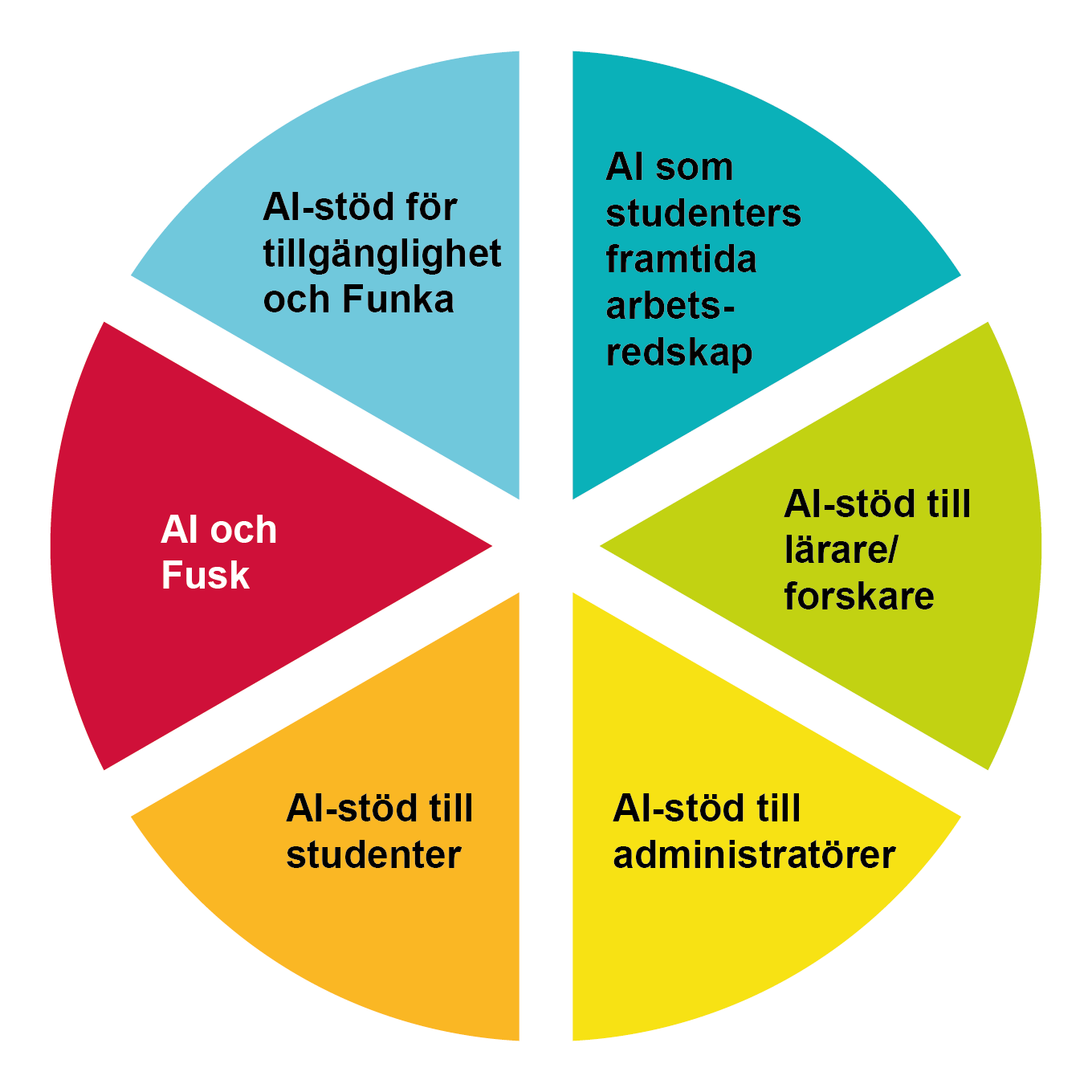 |
Go back to AI start page |
More information
Reading materials
- Living guidelines on the responsible use of generative AI in research_ (European Commission, Third version, May 2026)
- European Code of Conduct for Research Integrity (2023 Revised Edition)_allea(All European Academies, 2023)
Recorded AI skills seminars
- What is AI? SLU play, run time 53 mins. English.
- How to talk to AI? SLU play, run time 52 mins. English.
- Integrity and Ethics with genAI. SLU play, run time 56 mins. English.