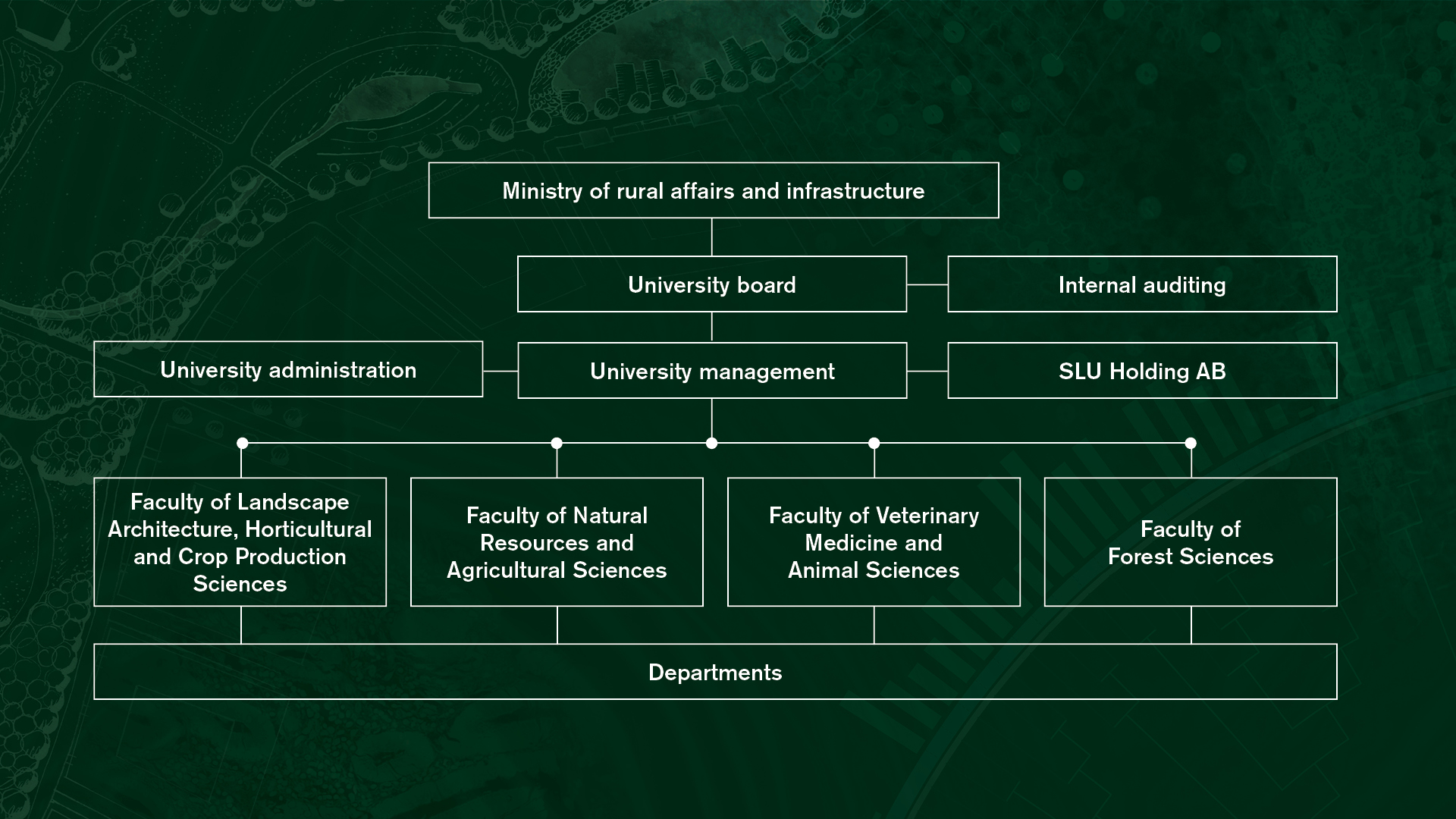
SLU falls under the Ministry of Rural Affairs and Infrastructure. The SLU Board is responsible for the overall direction and budget of the university. The senior management team – comprising the vice-chancellor, deans and chief operating officer – leads strategic development and ensures the quality of operations.
The four faculties consist of departments that conduct research and education in their respective fields. The university administration provides operational support and services in areas such as finance, HR, communications and infrastructure.
The internal audit contributes to quality assurance, and SLU Holding AB contributes to knowledge dissemination and innovation activities.
SLU's governance structure for education involves all parts of the university to ensure quality and relevance.
Read more below about how SLU is organised:
Ministry
SLU Board
University management
Faculties and departments
University administration & library
Internal audit
SLU Holding
Educational bodies
Governance structure
Ministry
Since its foundation in 1977, SLU has fallen under the Ministry of Agriculture, now the Ministry of Rural Affairs and Infrastructure. Other universities and university colleges in Sweden fall under the Ministry of Education.
SLU Board
The SLU Board has overall responsibility for the university’s strategic direction and budget. In addition to the chair of the board and the vice-chancellor, it comprises representatives of the university's teaching staff and students, as well as representatives from the business community and public organisations.
University management
The university management consists of the vice-chancellor, the deputy vice-chancellor and the pro vice-chancellors, the deans and the chief operating officer. They are responsible for ensuring that SLU is a successful and attractive university for students, researchers and other staff. This includes developing visions and plans to guide SLU's development, ensuring high quality in education and research and using the university's resources in the best possible way.
Faculties and departments
A faculty is responsible for the activities of a particular scientific field. Its highest decision-making body is the faculty board, chaired by the dean. SLU has four faculties. Each faculty has an office that provides administrative support. This is headed by the head of faculty administration.
Each faculty consists of a number of departments, where education and research are conducted in specific subject areas. Each faculty, and several departments, also carry out environmental monitoring and assessment. Each department is headed by a head of department.
Faculty of Landscape Architecture, Horticultural and Plant Production Sciences (LTV)
Faculty of Natural Resources and Agricultural Sciences (NJ)
Faculty of Forest Sciences (S)
Faculty of Veterinary Medicine and Animal Science (VH)
Departments
University administration/Operational support
The university administration consists of a number of central administrative divisions that support academic activities in areas such as finance, communication and infrastructure. The chief operating officer heads the university administration.
The SLU Library
As of 2026, the library is part of the university administration. The library provides support for research, studies and knowledge dissemination.
Internal audit
Through auditing and advisory work, the Internal Audit Unit supports SLU in conducting the best operations possible. The results of the audits are reported to the SLU Board.
SLU Holding
SLU Holding AB is a state-owned company managed by SLU, which runs the university's innovation office on behalf of SLU.
Educational bodies
“As the accountable authority, the Government shall establish higher education institutions for the provision of courses and study programmes based on scholarship or artistic practice and on proven experience". (Higher Education Act (1992:1434) Chapter 1).
Responsibility for SLU's education at undergraduate and Master’s level is shared between the SLU Board, the vice-chancellor, the Board of Education, faculties, programme boards and departments.
These educational bodies constitute the university's governing and decision-making structure for education, and include the Board of Education, the programme boards, programme directors of study, joint councils and the students’ unions.
The delegations of authority describe how responsibilities and powers are distributed between the different bodies responsible for education governance.
The financial framework for education is described in the allocation of funds for SLU as a whole and for each faculty, as well as the university administration and the library.
How education governance is organised
- The SLU Board
Has overall responsibility for the university's activities and decides on its strategic direction, objectives and resources, including education.
- Vice-chancellor
Manages the day-to-day business and is responsible for implementing the Board's decisions. The vice-chancellor appoints or delegates tasks to the Board of Education and the deans.
- Board of Education
The university's central educational body. It prepares matters relating to the quality, content and development of programmes and interacts with the programme boards. The Board of Education proposes the allocation of government funding to programmes as well as for common purposes, which the SLU Board then decides on.
- Programme boards
Each faculty has a programme board, which is responsible for the planning, implementation, quality and monitoring of courses and programmes in its field. They report to both the Board of Education and the respective faculty board. The programme boards propose the allocation of government funding to courses as well as for common purposes at their respective faculty, which the faculty boards then decide on.
- Programme directors of studies
Act as the operational link between programme boards and departments. They coordinate courses within programmes and ensure the progression and quality of education.
- Faculty boards and deans
Have formal responsibility for education within their respective faculty. The dean leads the work of the faculty and participates in the overall management of the university.
- Departments and heads of departments
Deliver courses and programmes and are responsible for teaching, assessment and the students' working environment.