Systematic quality assurance of research and environmental monitoring and assessment
Last changed: 02 February 2026
Overview of the quality system
The key elements of the quality assurance system for research and environmental monitoring and assessment are baseline analyses and quality dialogues at all levels within SLU – department, faculty and university-wide. The baseline analyses are carried out in four-year cycles (see Figure 1). Every second cycle (that is every eight years), they are complemented by an external assessment (the Quality and Impact Assessment).
The systematic quality assurance process is based on five quality areas, which describe the prerequisites for high-quality research and environmental assessment, and which are detailed at the end of this page.
Baseline analyses and quality dialogues aim to identify development needs in the various quality areas. The process results in measures at different organisational levels. In the intervening years of the four-year cycle, the focus is on follow-up. The quality assurance process is documented in the form of quality reports.
The systematic nature of the cyclical process thus follows this pattern:
- Analyse - the current situation in relation to a standard (i.e. an internal target) for each quality area. For the Quality and Impact Assessment, external assessors are involved.
- Identify - improvement/development measures.
- Implement - approved measures.
- Monitor - the implementation of agreed measures and results on an annual basis.
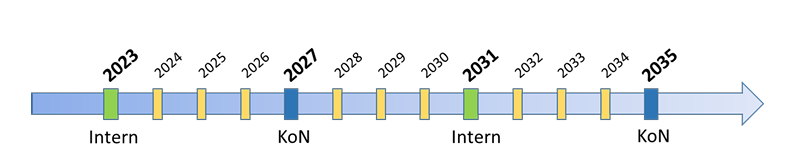
Figure 1. The timeline shows the four-year cycle for systematic quality assurance.
Green (intern=internal) and blue boxes refer to the years when the baseline analysis
is carried out. Blue boxes labelled KoN (Quality and Impact) refer to years when the
 quality assurance process also includes external assessment. The yellow lines
indicate the intervening years when the focus is on follow-up.
Process at department level
Baseline analysis
The four-year cycle starts with the department carrying out a baseline analysis covering the five quality areas (see end of this page). A new analysis is carried out every four years, and the years inbetween focus on the follow-up of activities and measures.
The baseline analysis requires the department to reflect on whether existing processes, procedures, division of responsibilities and operational support etc. function in a way that ensures that the standard for each quality area is met. When the Quality and Impact Assessment takes place, the results of the external assessment are also included. In cases where the standard is not met, development measures are described and the department plans the implementation of these. The department may also identify issues and challenges that it wishes to raise for dialogue with the faculty management.
The department adapts its approach to conditions and established procedures at the department. For the baseline analysis to contribute to the department’s quality efforts, staff must be involved. To support the baseline analysis, a dialogue tool is available on the staff web.
When the external peer review, Quality nad Impact, is carried out (every eight years), additional guidance on supporting documents will be provided.
Quality report
The result of the baseline analysis is presented in a quality report. The report forms the basis for the quality dialogue between department and faculty management (see below). The quality report provides a brief summary of the baseline analysis, along with a description of the measures that the department plans to implement based on the needs identified within that analysis. Issues and challenges to be raised for dialogue with the faculty management are also described.
The quality report also includes a brief description of how the baseline analysis was carried out at the department. A template for the quality report is provided on the staff web.
In the subsequent years, the quality report is updated annually with concise information regarding the progress of the measures being implemented by the department.
Quality dialogue between department and faculty management
The quality dialogue takes place as part of the regular, annual operations dialogue. The purpose is to use the baseline analysis as a basis for holding an open and forward-looking discussion on quality issues and the need for development. The quality dialogue includes a review of the measures that the department plans to implement. In the intervening years (when no new baseline analysis is carried out), the focus of the quality dialogues is on the follow-up of approved measures, any need for adjustments to these, and any new measures.
Process at faculty level
Baseline analysis
Based on the departments' quality reports, quality dialogues and other relevant evaluations and data, an analysis and synthesis of the current situation at the faculty as a whole is made. An important part of the analysis is to identify recurring themes or challenges in the departments' quality reports, as well as development needs. Those years when the Quality and Impact Assessment takes place, the results of the external assessment are also included.
Quality report
The faculty prepares a quality report, which includes a summary of the baseline analysis and a description of the development measures it plans to implement based on the needs identified in the analysis. Furthermore, it also describes development needs that the faculty wants to raise for discussion at the university-wide level. The quality report provides documentation and a basis for the quality dialogue with the vice-chancellor. A template for the quality report is available on the staff web. In the intervening years, the quality report is updated with concise information on how the implementation of measures is progressing at the faculty.
Quality dialogue between faculty management and the vice-chancellor
The quality dialogue is conducted in connection with the annual operational dialogues (‘faculty dialogues’) between the vice-chancellor and each dean/faculty management. The purpose is to use the quality reports as a basis for holding a forward-looking discussion on quality issues and development needs. The faculty informs about the development measures it plans to implement based on the baseline analysis and the quality dialogue with the departments. There is also a discussion on challenges at the university-wide level.
In the intervening years, the focus of the quality dialogues is on the follow-up of approved measures, any need for adjustments to these, and any new measures.