Facts:
* Aquatic food webs consist of many different types of organisms living in interconnected habitats. Algae and bacteria form the base of the food web, supporting zooplankton and other invertebrates, which in turn provide food for fish.

On Monday (2 November), Benjamin Mooney formally pinned his doctoral thesis, “Restructuring aquatic food webs under climate change”, in the Aqua Room at Ultuna in Uppsala.
– Making this thesis a reality was a collaborative effort, supported by people and resources across numerous institutes, extensive help in the field and in the lab, and countless coffee room chats. The learning curve was steep yet incredibly rewarding. Overall, it has been a fantastic four years where I have met amazing people, learned many skills, and got to contribute to the field of food web ecology. Oh, and I was two-time university champion of Mario Kart, says Ben.
In his thesis, Ben investigates how climate-related environmental changes, such as warmer water and changes in the supply of nutrients and organic matter from land, affect the biomass of different groups of organisms in northern aquatic food webs*. Ben has focused particularly on how these changes affect the abundance of organisms at different levels of the food web, from algae and bacteria to zooplankton and fish, and on what determines whether changes at the base of the food web also affect organisms higher up, such as fish.
To investigate this, Ben analysed data from 125 Swedish lakes and collected samples at eight sites along the northern Baltic Sea coast. He also conducted experiments in outdoor tanks to investigate how temperature, nutrient availability and bottom habitats affect interactions between different organisms.
Ben’s results show, among other things, that warming generally increases the abundance of organisms at the base of the food web, particularly algae. However, more algae does not automatically lead to greater biomass of zooplankton and fish. The effects depend on several factors, including nutrient availability, the presence of predators, and whether organisms live on the bottom or in the open water.
Here you can read the thesis: Restructuring aquatic food webs under climate change.
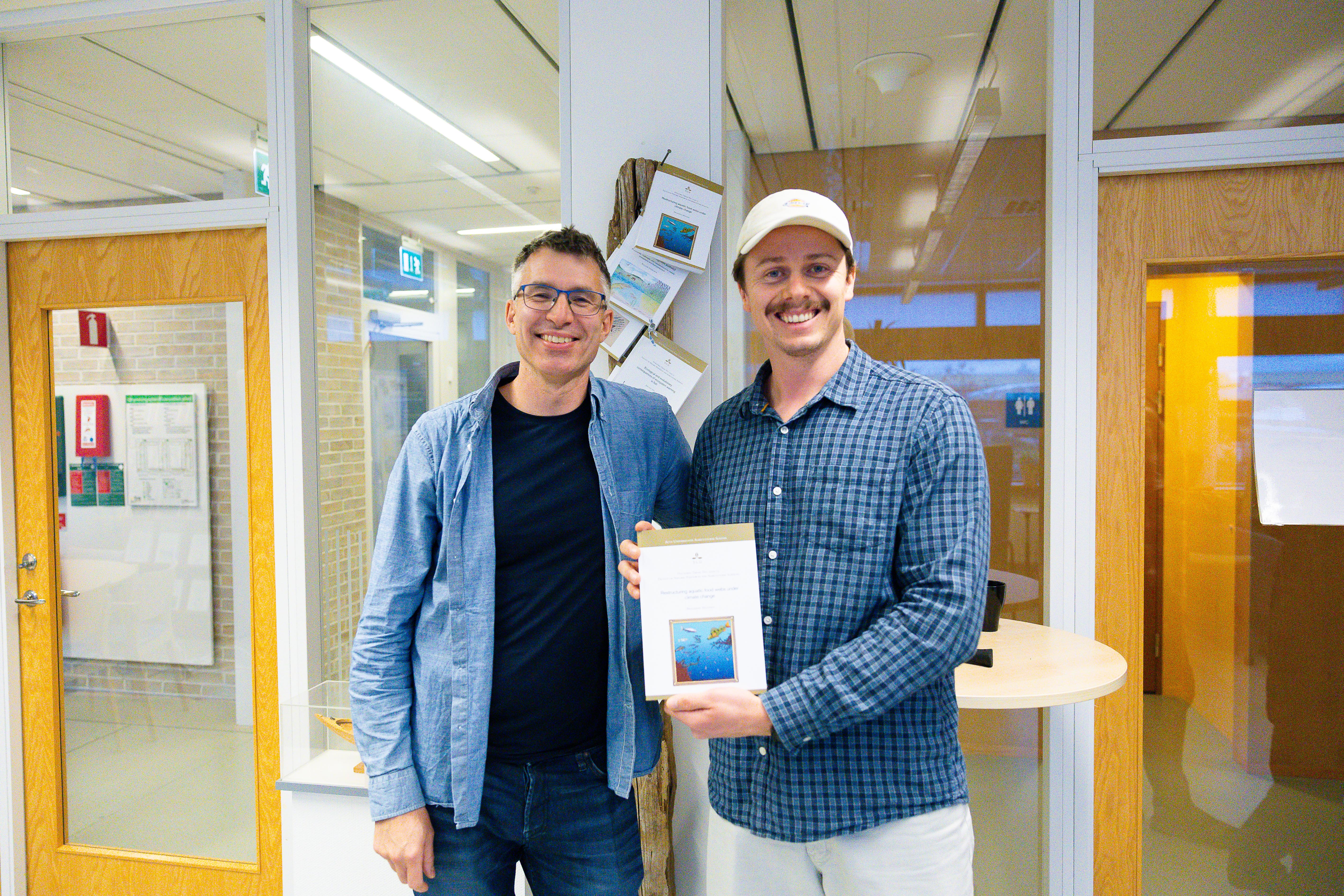
Ben together with his main supervisor Magnus Huss.
Would you like to attend the defence? You are warmly welcome to Uppsala on Friday November 20 at 1 pm.
When: Friday, November 20 at 1-4 pm.
Where: Audhumbla lecture theatre, VHC-house 5, SLU Campus Ultuna.
Join online: Zoom. Code: 328535.
* Aquatic food webs consist of many different types of organisms living in interconnected habitats. Algae and bacteria form the base of the food web, supporting zooplankton and other invertebrates, which in turn provide food for fish.