Contact
Division of Planning, Enheten för forskning
During a six-year cycle, all first-cycle and second-cycle degree programmes at SLU are evaluated using an established process for quality assurance of education, based on defined quality areas. The key elements of the process are baseline analyses, external peer reviews and quality dialogues at different levels within SLU; the process aims to ensure the quality of the programmes and identify development needs in the different quality areas.
The process results in a quality report describing the implementation of the quality assurance process, action plans containing programme-specific development measures and general development measures linked to the university administration’s support functions for education.
The purpose of systematic quality assurance is to:
The quality assurance process for education has eight components, and the evaluation takes place over a year; however, the quality assurance process starts the year before the evaluation takes place and ends the year after.

The Division of Planning and Research Support organises a kick-off meeting for programme board chairs, programme directors of studies, faculty programme directors/education officers and Sluss. The purpose of the start-up meeting is to inform about the upcoming quality assurance process, when the distribution of documentation and key figures for the preparation of the baseline analysis will take place and to begin appointing external assessors.
The programme boards, as instructed, prepare proposals for external assessors to be appointed by the Board of Education.
The programme boards are responsible for producing and establishing the baseline analysis based on SLU's quality standards and according to the instructions and supporting documents provided.
Sluss submits the students' comments on the baseline analysis.
The assessment panel reviews the baseline analysis and interviews programme coordinators, teachers and students during an online site visit. The assessment panel then draws up an assessment report containing identified strengths and areas for improvement.
Based on the baseline analysis and the assessment panel's proposed areas for improvement, the quality of the programmes is discussed in a quality dialogue led by the chair of the Board of Education. The other participants are a member of the Board of Education, the chair of the programme board, the programme director of studies, the head of department or equivalent, a teacher representative, the faculty programme director/education officer, a student representative appointed by Sluss and the external assessors. The Division of Planning and Research Support is responsible for taking minutes.
After weighing together the baseline analysis, the assessment report and the quality dialogue, the Division of Planning and Research Support produces a draft quality report and programme-specific action plans. Programme board chairs, programme directors of study, faculty programme directors/education officers and Sluss comment on the drafts before the Board of Education meeting.
The Board of Education reviews and approves the quality report describing the quality assurance process and general development measures linked to the university administrations’s operational support. The Board of Education adopts action plans with programme-specific development measures for each programme that has been evaluated.
The Board of Education assesses the quality of the programmes under review, covering both content and the prerequisites for quality, and issues an opinion and decides on follow-up. If the quality is assessed as being sufficient, follow-up takes place according to normal procedures; in the case of questionable quality, follow-up takes place through special procedures and a reassessment takes place according to instructions.
At the reassessment, the Board of Education decides whether the quality deficiencies have been addressed and the programme quality and conditions are satisfactory, allowing quality work to continue under standard procedures, or whether the programme should be discontinued.
The outcome of reviews and continuous monitoring is documented and communicated to the organisation. The documents are published on SLU's web pages for systematic quality assurance and made available to students.
Each degree programme constitutes an evaluation unit and is required to produce a baseline analysis, undergo an external peer review resulting in an assessment report and participate in a quality dialogue to discuss areas for development. The Board of Education then adopts an action plan containing programme-specific quality enhancement measures. All degree programmes are divided into groups that are evaluated by a panel of external assessors.
For education other than regular degree programmes, such as freestanding courses, supplementary education or collaborative programmes where SLU does not have the main responsibility, evaluation is done as per separate instructions.
Each assessment panel consists of external assessors from other higher education institutions and a student representative. The number of assessors depends on the scope of the evaluation and the conditions, and including labour market representatives on some assessment panels may be justified. The programme boards, as instructed, prepare proposals for external assessors who are appointed by the Board of Education, and Sluss appoints a student representative.
A timetable has been produced as an annex to the plan for systematic quality assurance of first- and second-cycle programmes. The timetable describes when all programmes at SLU will be evaluated during the period 2026–2031.
If there are special reasons, or if a programme appears to have serious quality shortcomings, the Board of Education can decide on a time for review that is different from the regular schedule.
The action plans are followed up annually by each programme board and the Board of Education. The chairs of the programme boards, who have the right to attend and speak at Board of Education meetings, report annually to the Board of Education on the progress of the action plan measures. The chair of the Board of Education reports annually to the board on the university administration’s ongoing quality efforts.
At the vice-chancellor's annual quality dialogues, which form an integral part of the vice-chancellor's faculty dialogues, the different parts of the quality system – research and environmental monitoring and assessment, third-cycle education, and first- and second-cycle education – are brought together and the faculties comment on the outcome of the previous year's quality assurance; they can also propose general development measures for education or operational support.
The vice-chancellor reports annually to the SLU Board on the results of the quality assurance processes and the work on measures in the areas research and environmental assessment and education at first-, second- and third-cycle level.
The quality system is monitored annually when the Board of Education adopts quality reports and action plans and during the vice-chancellor's quality dialogues to ensure that it is functioning effectively and driving quality.
The Division of Planning and Research Support, which coordinates the university's quality work, develops proposals for improving the quality system based on the above follow-up activities, as required. Needs for improvements may emerge during the quality assurance process or be identified by the vice-chancellor, the Board of Education or the Council for PhD Education.
The responsibility for quality is borne by the whole university, and is distributed within the organisation with its decision-making levels and rules of procedure.
The SLU Board is responsible for the overall direction of SLU's operations. The vice-chancellor is the head of the university and has overall responsibility, under the SLU Board, for the management of operations.
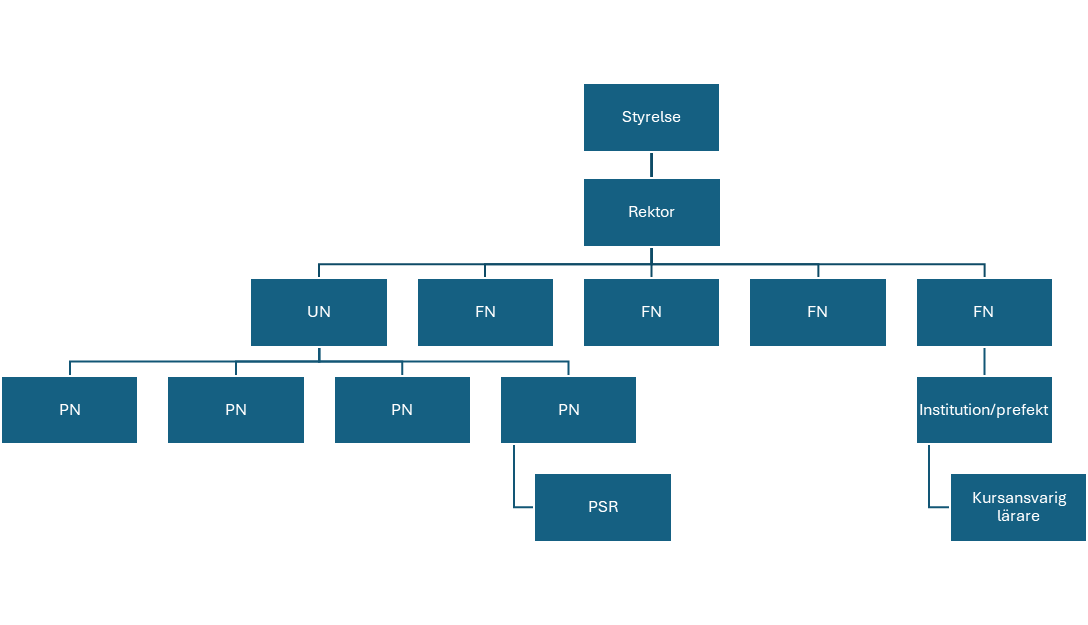
Responsibility for the quality of first- and second-cycle courses and programmes is assigned based on the university's delegations of authority and is summarised in the figure below.

The Board of Education (UN), which is directly subordinate to the SLU Board, has overall responsibility for education at first- and second-cycle level. The UN is a joint SLU body tasked with addressing strategic issues related to the quality of education, and to support, coordinate, stimulate and develop all education at first- and second-cycle level. The UN's remit includes submitting annual proposals to the vice-chancellor on the university's range of degree programmes and, where appropriate, submitting proposals to the vice-chancellor on the establishment and discontinuation of degree programmes.
There are four programme boards (PN), which are responsible for ensuring the quality of degree programmes and freestanding courses. For each programme, the PN must appoint a programme director of studies (PSR) responsible for developing the academic progression and quality of the programme.
The faculty boards (FN), which are subordinate to the SLU Board, are responsible for ensuring that activities are organised in such a way that high-quality education is achieved. The UN, through the planning of teaching positions, provides the prerequisites for high-quality education on a scientific or artistic basis and based on proven experience. The UN appoints members to each PN.
The heads of department are responsible for ensuring that high quality education is provided in their respective departments, using the resources allocated for this. The head of department is responsible for developing a good spirit and creative environment for staff and students in the department, including student welfare issues. The department responsible for a course appoints the teacher responsible for delivering the course.
The Division of Planning and Research Support has overall responsibility for supporting and coordinating the processes for quality assurance and follow-up. This includes designing templates and drafting instructions and procedures for quality assurance and follow-up, producing key figures and data for the preparation of baseline analyses, providing administrative support to the assessment panels, organising quality dialogues and taking notes at these, and producing quality reports and action plans.
The Board of Education is expected to:
- appoint assessment panels for each review round;
- appoint a member to participate in quality dialogues;
- assess the quality and quality performance of programmes and provide feedback;
- review and adopt quality reports and action plans with programme-specific development measures; follow up on the results of these measures;
- monitor the quality system to ensure that it is functioning effectively and driving quality.
Programme boards are expected to:
- develop proposals for assessors for each review round in accordance with instructions;
- for the review by the assessment panel and the quality dialogues, and for each programme to be reviewed, to prepare supporting documents as per the instructions provided;
- involve programme directors of study in the systematic quality assurance process and ensure that staff involved in the education process are given the opportunity to contribute to supporting documents;
- capture the experience and views of the teaching staff in an appropriate forum (e.g. quality seminars or workshops with department directors of studies or equivalent, course coordinators, examiners and teachers);
- plan work so that student representatives are given the opportunity to participate in the preparation of the supporting documents;
- based on the given framework, appoint participants to the quality dialogues:
- implement the improvement measures set out in the action plan in accordance with the decisions of the Board of Education, and report back according to the planned follow-up.
Sluss is expected to:
- appoint student representatives to participate in the quality dialogues;
- contribute to effective communication between the relevant student representatives and programme managers involved in the evaluation process;
- comment on the baseline analysis submitted by programme boards and the quality report and action plan for decision by the Board of Education.
The external assessors are expected to:
- bring an external perspective to the review of SLU's programmes.
The chief operating officer is expected to:
- implement and follow up on identified actions within the university administration’s operational support;
- report back to the UN on the university administration’s quality efforts.
Heads of division within the university administration are expected to:
- prepare documentation for the quality dialogues as per the instructions provided;
- based on the given framework, appoint participants to the quality dialogues;
- implement the agreed development measures as decided by the chief operating officer, and to report back according to the planned followup.
SLU structures its quality work in six quality areas, which support the different phases of the educational process:
1. Recruitment, admission and introduction to studies
2. Study and learning environment
3. Programme design, content and results
4. Teaching and supervision
5. Education administration and support
6. Transition to working life and career
1. Recruitment, admission and introduction to studies
References: ESG 1.4, ESG 1.8, HL Chap 1 Section 5.
Standard:
SLU provides the conditions for prospective students to make informed educational choices. SLU has a broad and active recruitment process. The students admitted have the right prior knowledge. New students are given an appropriate introduction to the programme, their campus and SLU.
2. Study and learning environment
References: ESG 1.6, ESG 1.7, HL Chapter 1 Section 4, HL Chapter 1 Section 4a, HL Chapter 1 Section 5.
Standard:
SLU gives students the opportunity to take an active part in the improvement of programmes. The physical and social environment facilitates students' ability to complete the programme successfully. Programmes are delivered in an internationally welcoming study environment.
3. Programme design, content and results
References: ESG 1.2, ESG 1.3, ESG 1.4, ESG 1.5, ESG 1.6, ESG 1.9, HL Chapter 1 Section 3, HL Chapter 1 Section 5, HL Chapter 1 Section 8, HL Chapter 1 Section 9, FSLU Annex: List of qualifications.
Standard:
SLU's programmes are closely linked to research and society. SLU's mission statement is clear in all programmes. Each programme is designed to enable students to achieve the degree objectives. The sustainable development perspective is integrated in all courses and programmes, as are mainstreaming and an international perspective.
4. Teaching and supervision
References: ESG 1.3, ESG 1.5.
Standard:
SLU's programmes have a student-centred learning approach. Programmes are designed to ensure effective learning and there are links to research. Teachers have the potential to develop their scientific, artistic and pedagogical competences.
5. Education administration and support
References: ESG 1.2, ESG 1.3, ESG 1.4, ESG 1.6, ESG 1.7, FL Sections 4 and 7.
Standard:
The education administration at SLU is competent, efficient and transparent. SLU's students are provided with the conditions to make informed decisions about study and career choices.
6. Transition to working life and career
References: HL Chapter 1 Section 2, HF Chapter 1 Section 11.
Standard:
SLU's programmes provide students with the right conditions for a successful future working life.
References:
ESG = Standards and guidelines for quality assurance in the European area of higher education, adopted at the Ministerial Conference in Yerevan, May 2015
HL = Higher Education Act, SFS 1992:1432
HF = Higher Education Ordinance, SFS 1993:100
FSLU = Ordinance for the Swedish University of Agricultural Sciences,
SFS 1993:221 FL = Administrative Procedure Act, SFS 1986:223